Saturday, August 16, 2014

Israelite Info Part III: Tzitzit Everywhere

Hello again!
A couple of weeks ago, I wrote a post about what an Israelite looks like. The point was that an Israelite looks like a person, more or less; However, towards the end of the post, I hinted that if you observed closely, you would find some things unique about them. In this post, we will talk about one of those things--the ever-present tzitzit ("zeetzeet").

     "What is a tzitzit?" you might wonder, "Does it have any relation to tzatziki sauce?" Well, ponder no longer! A tzitzit is a type of tassel, usually worn on the corners of a garment. Alone, a tzitzit looks like this:
Pic from karaite-corner.org
     They are usually a combination of blue and white. They are woven to contain a certain number of twists and knots. They can be made at home, and are usually bought or created in sets of four.

Pic from gotcrochet.com
     For most Israelites, putting on their tzitzit in the morning is part of their morning routine, just like brushing their teeth. We receive this conviction from Numbers 15:38 (KJV), "Speak unto the children of Israel, and bid them that they make them fringes in the borders of their garments throughout their generations, and that they put upon the fringe of the borders a ribband of blue" and Deuteronomy 22:12 (KJV), "Thou shalt make thee twisted cords upon the four corners of thy covering, wherewith thou coverest thyself.". There is also some evidence that Yeshua himself wore the tzitzit, compounding the point that we should wear them  (Matthew 9:20), "Just then a woman who had suffered for twelve years with constant bleeding came up behind him. She touched the fringe of his robe". Now, if you follow the link for that last verse, you'll see a variety of translations: some of the time, it is called "the edge of his cloak", and sometimes, "the fringe of his garment", so there is room for debate there. I'm not going to get into that; I'm on the side of the debate that the "fringe" in question is the same fringe commanded in the Old Testament to the children of Israel.

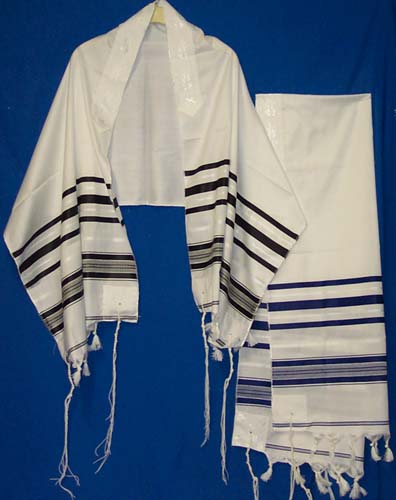
     Now, to the specifics. Israelites are not the only people on the planet who wear tzitzit. Jews also wear them, though they wear them in a different way. They wear their tzitzit connected to a tallit, a prayer shawl: 
Note the fringes on the corner of the shawl.
Picture from theshofarman.com
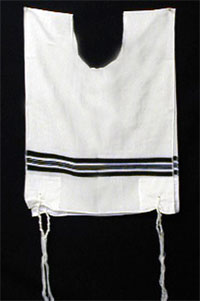
Or, they wear their tzitzit on a tallit katan, a type of undergarment. It's a rectangular piece of cloth with a hole in the middle. The tzitzit are connected to the corners of this garment, and it is worn with one's head through the hole, underneath one's everyday clothes.
Pic from templestudy.com
    The thought behind wearing the tzitzit on a separate, special garment is as follows: The verse from Deuteronomy specifies that one should wear the tzitzit on "the four corners of thy covering". Some historical context is needed here. Due to the technology at the time, most clothing was made from rectangular pieces of cloth, draped, wrapped, sewn, and worn in different ways. As the clothing was made from rectangular cloth, all garments had "corners". (A great explanation for the process and different types of clothing items can be found here). Nowadays, very few clothing items have what can be called "corners". So, the reasoning follows, if there are no corners on your clothes, wear something with corners. Jews follow this reasoning, as do some Israelites.
     The "type" of Israelite I am (no denominations, rather a way of thinking) reasons that corners were called for because everyone had corners on their clothes. The clothes were not special; they were just what people wore. Ergo, today, we don't need special clothing to put the tzitzit on, so we just attach them to our everyday wear. Typical methods are clipping the tzitzit to belt loops using a small carabiner or attaching them using a lark's head knot.
Shown here, the lark's head method on a skirt I own
    It may seem from what you've read here that the wearing of tzitzit is an arbitrary-type law. It is not so; the expressed purpose of tzitzit given in Numbers 15:39-40, "And it shall be unto you for a fringe, that ye may look upon it, and remember all the commandments of the Lord, and do them ; and that ye seek not after your own heart and your own eyes, after which ye use to go a whoring: That ye may remember, and do all my commandments, and be holy unto your God."
     So, much like a red string tied around your finger, tzitzit are for remembrance of the Law. When we wear them, they serve as a constant reminder as to how we should act.
     Have you ever seen tzitzit in your everyday life? Have you considered wearing them or known someone who wears them? Let us know in the comments!

Saturday, August 2, 2014

Israelite Info Part II: How Does One Become an Israelite?

 In the Old Testament, Israelites are often referred to as "the Children of Israel". Israel, in the Early Old Testament, referred to a man, Jacob. This Jacob was the son of Isaac and grandson of Abraham. He fathered the twelve sons who became the patriarchs of the twelve tribes. Jacob was renamed Israel by YHWH; you can look in Genesis 32 for the story. So, the "Children of Israel" would refer to the descendants of the man, Israel. However, as I said above, the title "Israelite" is not one you inherit from birth.

     The Nation of Israel (as you will) was more or less solidified when YHWH brought them out of the land of Egypt. Prior to this, they had been in communication with Him, but He hadn't given them their identity yet; there was no Law, no binding principle to show kinship--all they had was their shared blood.
     When Moses led the children of Israel out of Egypt where they had been enslaved, they did not leave alone. Along with them came "a mixed multitude" (Exodus 12:38). After they left Egypt, YHWH gave Moses the law (Torah). The key point is this: at that moment, the literal children of Israel and the mixed multitude became one: "All the congregation of Israel shall keep it. When a stranger shall sojourn with thee, and will keep the passover of the Lord, let all his males be circumcised, and then let him come near and keep it; and he shall be as one that is born in the land...One law shall be to him that is homeborn, and unto the stranger that sojourneth among you" (Exodus 12:47-49, KJV, emphasis added). This passage refers to the feast of Passover directly, but indirectly, it shows what is necessary to be considered "one of the congregation", ie: one of the people. Foreigners were not allowed to keep the passover. Strangers were not allowed to keep the passover (Exodus 12:45 and :43, respectively). A stranger who sojourns, however, was allowed to participate in Passover. The law applies to both blood Israelites and those who wish to keep it. The merger is explained more clearly in Leviticus 19:33-34, "And if a stranger sojourn with thee in your land, ye shall not vex him... the stranger that dwelleth with you shall be unto you as one born among you, and thou shalt love him as thyself; for ye were strangers in the land of Egypt: I am the Lord your God". Therefore, it is established, a person who sojourns with Israel is the same as a person born into Israel.

    But, you may wonder, if one is a sojourner, rather than a blood-born Israelite, does one still have to keep the Law? I would first refer to the above, "One law shall be unto him that is homeborn, and unto the stranger who sojourneth with you", but also to the punishments for breaking of the law. 
     Punishments for breaking the law vary. A thief must return the stolen item along with an added 1/5 of the item's value (Leviticus 6:1-5). Murderers were executed (Leviticus 24:17). There is another punishment, seemingly more serious and direful than execution--being "cut off". Being "cut off" refers to the practice of banishment, not just physically, but spiritually. A person "cut off" from Israel must leave the land and loses all claim to the faith. They are no longer protected or blessed. Their connection and agreement with YHWH is severed. 
     The agreement with YHWH includes such deals as, "Wherefore ye ye shall do My statues, and keep My judgments, and do them; and ye shall dwell in the land in safety" (Leviticus 25:18), "If ye walk in My statutes, and keep My commandments, and do them; Then I will give you rain in due season, and the land shall yield her increase, and the trees of the field shall yield their fruit" (Leviticus 26:3-4). It's rather simple, if A, then B. Being one of Israel, if A, ties one into the blessings and protection of Israel, B. Being cut off puts one in line for the curses, C. (Look in Deuteronomy 28, starting with verse 15, for the full list of curses; they are thorough, creative, and variable). Being cut off looks something like this: 

But if it shall come to pass, if thou wilt not hearken unto the voice of the Lord thy God to observe to do all His commandments and His statutes which I command thee this day; that all these curses shall come upon thee, and overtake thee: Cursed shalt thou be in the city, and cursed shalt thou be in the field...Cursed shall be the fruit of thy body, and the fruit of thy land...The Lord shall send upon thee cursing, vexation, and rebuke, in all that thou settest thine hand unto for to do, until thou be destroyed, and until thou perish quickly...the Lord shall make the pestilence cleave unto thee, until He have consumed thee from off the land, whither thou goest to possess it...And thy life shall hang in doubt before thee; and thou shalt fear day and night, and shalt have none assurance of thy life.

    In a word; Damn.
    It continues in Deuteronomy 29:24-29, "Even all nations shall say, 'Wherefore hath the Lord done thus unto this land? what meanest the heat of this great anger?' Then men shall say, 'Because they have forsaken the covenant of the Lord God of their fathers, which He made with them when He brought them forth out of the land of Egypt: For they went and served other gods, and worshiped them, gods whom they knew not, and whom He had not given unto them. And the anger of the lord was kindled against their land, to bring upon it all the curses that are written in this book:...those things which are revealed belong unto us and unto our children for ever, that we may do all the words of this law."


    These promises of punishment count equally for those "born in the land" and the "sojourners", because they are the same people. A "sojourner" Israelite suffers the same punishment as a blood Israelite; The law applies to all people. Never say it's all doom and gloom, however. There are positive promises, as we before mentioned (see the first part of Deuteronomy 28 for the comprehensive list; they are also thorough, creative, and variable). Even if an Israelite chose option C, YHWH allows for them to realize their mistakes and return to Israel with full benefits--Deuteronomy 30:1-5. [Forgiveness is not the sole province of the New Testament]

    Now, this started out as a light-hearted post, showing you that Israelites look like other people. (If you were one of the observant folks and noticed some similarities between the people in the photos in dress, congratulations :) you have discovered the topic for the next couple posts in this series.) Though the message got a bit threatening in the middle, that is not the point or intention. 

The point is this: an Israelite can be anybody, regardless of sex, race, creed, or past. 
An Israelite can be you.


 "Keep therefore the words of this covenant, and do them, that ye may prosper in all that ye do" (Deuteronomy 29:9). 

Israelite Info Part I: What Does an Israelite Look Like?

Now that I've made a little headway into informing on the topic of what an Israelite is or believes, it's time to put a face (or faces) to the movement. So, what does an Israelite look like? Could you pick one from a crowd if you knew what you were looking for? Do they have any special facial characteristics? Is there a uniform? What is requirements must be met? It may seem like a simple inquiry, but this question is going to kick off my first article series (Look out for parts II, III and IV!). By the end of it, I hope I will have thoroughly answered all of these questions.


For today, I just want to share some pictures of family and friends, showing you what Israelites look like (all of these pictures are used with the permission of the photo owners).

For starters, let's look at some Israelite families:

The F. Family (some of them)


k
The T. Family

The P. Family


The F. Family (some of them)
The F. and M. Families

Israelite friends:


Quick! Can you spot the Israelites?
How about here?


Israelites at Work....


Israelites at Play....


Israelites far away
Now, you may have found the "Find the Israelite" game easy after a few pictures, noticing that there were a few repeating characters. However, the point was this: Israelites are no one race or age. There is no uniform. Though we are serious about our religion, we are not marked in our solemnity. We go to different places with different people. We go out to eat, participate in sports, and celebrate life's milestones. If we were walking in a crowd with you, you may not notice us at all.

There are no genetic requirements. There are no age requirements. There is no personality requirement. It is not something you are guaranteed based on any of your existing attributes. This question naturally follows: How does one become an Israelite?


Saturday, July 26, 2014

Sven Speaks: Long Hair, Don't Care

     Hey there, this is Kat's husband Sven. I believe she's mentioned me at least once or twice by now. From time to time I might chime in with an article of my own about subjects that are interesting or important to me. Welcome to the first installment of Sven Speaks! In this article I'll be talking about something that isn't overly controversial, but is something I'm personally invested in--long hair on a man. Buckle up, it's gonna be a long ride.

    The general consensus amongst Christians and most likely Israelites (I haven't really asked around about it) is if a man has hair below his ears his hair is too long. As a man with hair down to about four inches above the bottom of his rib cage, you could say I disagree. All the hubbub surrounding the length of a man's hair comes from 1st Corinthians 11:14. In the King James it says, "Doth not even nature itself teach you, that, if a man have long hair, it is a shame unto him?". The next verse, and I paraphrase, tells us that women having long hair is glorious. When viewed in a vacuum, that verse seems pretty clear cut. If A) men have long hair, then B) they should be ashamed. However, like all things, the Word does not exist in a vacuum. To understand what he means specifically by "long hair", we need to look at the context of when, where, and why Paul is writing.

     To begin establishing context, let's look at what this particular book of the Bible actually is. Corinthians, like other books in the Bible, is a letter from Paul to a group of believers in another city. He'd give advice, explain things, etc. etc. In this case, as the name would suggest, he's writing to the people of Corinth. Corinth was a city in more or less the center of Greece. For reference, here's where Corinth was located.
At the time Paul was writing, Corinth was owned by the Roman Empire. For the sake of brevity, I'll say that this is important because the Romans would have allowed the people of Corinth to act distinctly Greek (this will be fairly important later).

     Now that we've established the when and where, let's talk about the why. Paul was writing to Corinth to address specific concerns of the congregation there. There were quite a few issues going on in the city, but one of the biggest, one talked about very often in these letters, was the problem of fornication. Now this wasn't some run of the mill fornication you see going down in clubs and bars in America. No, this was on a whole different scale. There was incest, prostitution (religious and otherwise), adultery, homosexuality, and most importantly for this article, homosexual prostitution.

      In 1st Corinthians 6:9-10 we get a list of bad people who are getting the short end of the stick. "Know ye not that the unrighteous shall not inherit the kingdom of God? Be not deceived: neither fornicators, nor idolaters, nor adulterers, nor effeminate, nor abusers of themselves with mankind, Nor theives, nor covetous, nor drunkards, nor revilers, nor extortioners, shall inherit the kingdom of God." Safe to say Corinth wasn't doing so hot. The important word in that big long list is effeminate. You'll see that word translated different ways in different versions, but I like the way the KJV has done it. Paul was writing to the Greeks in Greek. In the words of my father-in-law, "I can't read Greek, but I can look it up". The word translated to 'effeminate' is from the Greek word "malakos". The word translates roughly to softness, or feminine, etc. In the context he's using it, it is referring to a homosexual male who is feminine. This means being the receiver of the homosexual relationship, but it goes further, the man is also demonstrating female attributes.

    I said earlier that the people of Corinth acting Greek was important. It is important in that the Greek world didn't view homosexuality in a negative light. Specifically sexual relations with young boys or men dressed as women. In Corinth there was rampant prostitution. This extended to homosexual male prostitutes dressed as females. They'd wear the clothing of women, they'd wear makeup like a woman, and most importantly for this article, they'd grow their hair long and style it like a woman. This is what Paul is referring to when he says that even nature shows that long hair is shameful on a man.

     Now I've said all of these things in order to say this; the long hair that is used to make you look feminine that Paul is talking about is not what modern religious people believe it is. I'll be approaching this from two angles. The first, that the definition of "long" is quite different from what many may think, and the second, that the length is less important than the style and intention of said long hair.

     When figuring out what "long" hair is, you need to realize that it is a very relative term. The hair is long as compared to what? If the long hair is meant to be like a woman's, then the length must be compared to the average man's hair, no? Not only that, we must see what a woman's hair would look like in order to compare it to that as well. So I'll be showing you what various cultures around the world and throughout time have seen as long hair. Since we're talking about turn of the millennium Greece, we'll start there first.
Note the man on the left's hair. It was far from uncommon to have men with shoulder length hair. Now let's look at how the women held their hair.
Women in Greece wore their hair in extremely intricate braids and buns (said extravagant braids are addressed in 1 Timothy 2:9). They may look short, but it is from the style. Note the top left woman. Her hair extends significantly further than the shoulder length hair men often wore.

     Now let's move on to some different cultures to illustrate that long hair is a completely subjective term. Let's visit Renaissance Italy next. 
This length of hair was very fashionable at the time, and was not considered long by any means. Now let's look at what his contemporary females were sporting.
That's a pretty significant difference. To have long hair in the Renaissance, you'd need to grow it for quite some time. 

     So let's move to one of the more fun periods to look at for this, the time of the Vikings.
The man in this painting has very long hair by today's standards (I use this because his hair is about my length in the back) but the length of the woman's hair is longer by quite a significant amount (in this painting I'm pretty sure that's a valkyrie, but it's not particularly important).

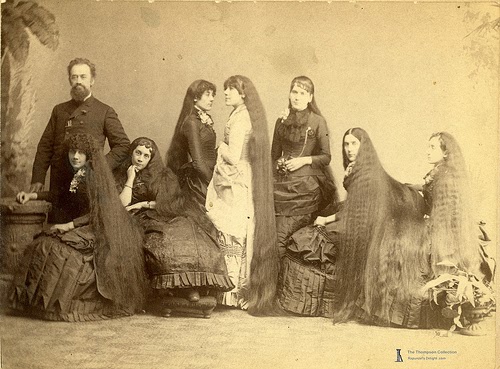
     In Victorian England, in order to be considered extremely feminine your hair had to be quite long, let's look at what length it was considered long.
Impressive, no? Makes that Viking or that Greek man look downright bald in comparison.

     What skews the modern American's view on the relative length of hair is our own fashion sense. In the 1950's, it was common for women to have hair well past their shoulders. Now, one's hair is considered long if it barely reaches your collar bones. Just look at the prevailing 'in' hairstyle for women.
 If a man was trying to distinguish himself from that, he'd have to be completely bald.

     So, I now come to my second angle of approach. When Paul is talking about long hair, he's meaning more than the length. He is also making a comment on the styling of the hair in order to appear like a female. If he was simply referring to length, he'd be contradicting the Bible itself, which we all (hopefully) know, the Bible just doesn't do. For proof I'll demonstrate two points in the Bible where long hair is not shameful in the least.

     First, we turn to 2 Samuel. In 2 Samuel 14 we learn about Absalom. In 2 Samuel 14:25-26 we read "But in all Israel there was none to be so much praised as Absalom for his beauty: from the sole of his foot even to the crown of his head there was no blemish in him. And when he polled his head, (for it was at every year's end that he polled it: because the hair was heavy on him, therefore he polled it) he weighed the hair of his head at two hundred shekels after the king's weight." Personally I prefer the translation to handsome than beauty, but it comes across mostly the same. So in there we learned three things. One, that he was praised above anyone else for being really really good looking. Two, he had not a blemish on him. Three, that man had a LOT of hair. At least according to the internet, 200 shekels converts to just under 73 Troy Ounces, or around 5 pounds in standard american weights. That is one hefty amount. Sure, his hair was obviously thick, but it must have also grown at a downright inhuman speed for it to get that heavy every single year. So, if it's quite long, but also very handsome and without blemish, that can only lead to the conclusion that having long hair must not be too bad.

     As my other example, we'll look at probably the most famous person in Judges: Samson. The man who had not cut his hair from birth. By the time of his death, his hair was unto a Sikh's, at least down past his butt. Was Samson shameful for having very long hair? Absolutely not. He was under a Nazarite vow. It was a holy thing for his hair to be long. If it was within God's will to have extremely long hair, how can Paul say that having long hair is shameful? Because he's simply not talking about the length as much as he is the intent of said hair. Now some might argue that long hair does in fact make you look feminine by default, and as such is wrong, to them I show these photos.


Try to tell me those three look feminine. If they look so to you, I've got some bad news about your taste in the ladies.

     So, to sum up, when Paul was writing to Corinth, he was addressing the issues of the city. The important one for us here, is that there were male prostitutes parading as women. To achieve this, they had long feminine hair. The cultural definition of long hair is significantly different than what many modern people believe. The length of the hair isn't even as important as the usage of it, as evidenced by Nazarites and Absalom.

     Thus ends the first edition of Sven Speaks. I promise any future posts by me will be significantly shorter, or at least be in multiple parts if they are this long.

Study Sabbath: Yeshua/Jesus Dichotomy

Hello again:
Today, I will be fulfilling one of my article promises--an explanation of the difference between "Jesus" and "Yeshua" and why it matters. I mentioned in my introductory post the controversy, but also that "Jesus" and "Yeshua" refer to the same person. This is deserving of a post and explanation of its own, so, here we go.

     To keep things clear, first, I will delve into the "sameness" of Jesus and Yeshua. Israelites believe Yeshua is the only son of God, born of a virgin, lived a perfect life, died (not on a cross--different post for a different time, perhaps) for the sins of the world (but specifically Israelites--different post for a different time--expect a series soon "What Makes an Israelite?"), came back to life three days after He died, spent some time kicking it around earth, then ascended to heaven. In short, He's the same guy you Christians are familiar with.

     Now, if he's the same guy, what does it matter what we call Him? "A rose by any other name would smell as sweet", right? Wrong. You will probably never hear an Israelite refer to ‘that guy’ as Jesus unless they're talking to a non/different-religious person to explain the concepts of our beliefs. Next, I'll explain where the difference comes from, followed by why it matters.

Where it comes from:
The name of 'that guy' mentioned above, in His native language, is "יֵשׁוּעַ". That language is Hebrew. Hebrew is the language of God's people, the Israelites, all the way to the beginning of the world. (If you’re interested in thisconcept/belief and have about an hour of free time, check out this video on youtube; it's fascinating).

So, His name was יֵשׁוּעַ, okay. Hebrew is a phonetic language, (like Hangul) and easy to learn, but I bet you can't read it. I can't read it. So, what was His name in English? "yēšūă". Now, as I mentioned before, I am an English teacher. I know a bit about language and pronunciation. The symbols up there above the letters mean it should be pronounced like so, "Yeh-sshoo-(ah)" (both the 'ssh' and 'ah' are short, slight sounds): Yeshua. The closest name we have in the English language to it is Joshua. Coincidentally, these names are very similar in Hebrew, in sound as well as meaning. Yeshua means "to rescue" or "to deliver", whereas Joshua (or, Yehoshua, as pronounced in the original Hebrew way) means "salvation" or, perhaps, "YHWH's gift". 

Well, now you know His actual name—but where does “Jesus” come from? It comes from the Greek version of His name. They translated it “Iesus”. The “J” came into play sometime between the late 1400s and mid 1500s in German. That’s right. The sound “j” didn’t exist in 1300. Fascinating. So, with time, the “j” made its way over to English, who’d been using the symbol “J” to stand for “y” (note, check out Scandinavian languages; they still use “J” for “Y”). So, His name was written “Jesus” with the understanding it would be pronounced “Yesus”, but, in time, we started using “J” for the “j” sound, and it became Jesus. (English is a fascinating bastard language; I could go on for days)

Alright. I hope you’re still following. What we’ve covered, the guy’s name is literally Yeshua, which, through translation of translation, led to calling him Jesus. To the nitty gritty, why does it matter, if we all mean the same guy?

(This is where my personal opinion comes in) Have you ever been to a foreign country? Talked to a foreign person about what your name would be in “their” language? The truth of the matter is, unless you have a name that is a literal noun, like “Faith” or “Summer” or “Pearl” (sorry, guys. There aren’t many straight forward noun names for you), your name will be the same. Or, it will be the same as much as the foreign language can pronounce it. For example, my first name is “Kat”. It’s pronounced just like the animal, “cat”. When I went to South Korea, the people there called me “캐트”, which sounds like “Keh-tu” (but they usually left the “u” off, making it “Keht”). Reason being Korean doesn’t have the long “aaaah” sound that is in the name Kat, but, they got as close as they could.

Bringing this back to the point, Jesus is nothing like Yeshua. The sounds are not similar. If Yeshua was walking down a crowded street, and you saw Him from afar and yelled, “Jesus!”, He would not turn around. It’s not His name.  It’s not what His friends called Him. It’s not what His enemies called Him. It’s not what His mom called Him. It’s not what His Dad called Him. It’s not what the angels told Mary to name Him. It’s just not His name. So, knowing what we know, why in the heck would we keep calling Him someone else’s name? We should be like the Koreans I had the joy of knowing. They got as close as they could. It’s only polite. You would be offended if someone constantly called you by someone else’s name, so why should be expect Him to be any different?

“Oh, well, He understands. He’ll hear me anyway”, you might say. He understands your blatant rudeness and willful ignorance? He understands your unwillingness to change a few small sounds in order to try to say his name correctly? I don’t think so. YHWH says not to misattribute his name or deeds to any other being several times in the Bible, (notably in the 10 Commandments), and I truly doubt His son thinks any differently.

Consider, who is this “Jesus” you are praying to? Can you really have a “deep” “personal” connection to a person whose name you refuse to learn or use? Yeshua is the name He was given, and after all His work to save our sorry hides, I think the least we can do is try to be polite to the guy.

Possible Sources: (Meaning, you can find this information all over)
For the linguistic side of things, check out the Oxford English Dictionary, Wikipedia.com, or any dictionary with a pronunciation guide at the beginning.
For an easy to read, all info-together explanation of Yeshua's name, check out this Wikipedia page (an English teacher? Using Wikipedia? Shocking! Actually, Wikipedia has checked out to be more accurate than the Encyclopedia Britannica, and it has the bonus of all the information in one place...).
If Wikipedia is not your style, feel free to check out the Yeshua/Jesus question using a Strong's Concordance, or a version of the Bible with extensive notes, such as the Companion Bible (King James' Version), or ask a friend who reads Hebrew, and so on, and so on.

Friday, July 25, 2014

A Day in the Life, or, "No bacon?!"

For those of you new to the concept of "Israelite", you may be wondering what a day in my life looks like. Is it terribly different from yours?

    The answer is, my life is rather like yours. I sleep in a bed, I drink coffee in the morning, I go to my job, I cook dinner with my husband, we watch movies, and so on and so on. However, there are some key differences that tend to pop out when compared to the life of your average American.

  Though I wouldn't say following the Law of God is exactly difficult, there are some big shifts from the way I used to do things. Some background: I'm only recently an Israelite. I was a non-denominational Christian until about four years ago. My parents were raised agnostic and Catholic, respectively. They cycled through Mormonism, Catholicism, and Protestantism before/during my young childhood. We eventually settled on "non denominational" because it seemed to be the most straight-forward the most lacking in what is colloquially known as "B.S.". Sometime in my teens, my dad became a pastor of our church (without formal training--remember, less B.S.). In our efforts to find the best, most truthful version of our religion, we stumbled upon Israelitism. Now, by "stumbled", I don't mean we talked to someone or found another church or read a book, I mean we realized what was already there, and began to do our best to adhere to it. (There'll be full explanation of this at some point, but I just want to cover the basics now). I won't lie; at first, the process was a little hinky. I was at college at the time, so a lot of what I was doing was on my own. I didn't understand some bits; I forgot others, but now, four years later, I think I'm doing alright.

So, the "biggest" differences, as some people see them:
   On Saturdays, called Sabbaths, I do not buy anything, I do not start fires, nor do I work. Our days begin and end at sundown, rather than at 12:00a.m. So, starting on Friday night, when the sun goes down, until Saturday night, when the sun goes down, I relax. I do not go shopping. I do not light my grill. I do not earn money. This works out rather well with my current job; as a teacher, I only need to be at school Monday-Friday. I do not grade papers on Sabbaths, and I don't plan lessons. When I was still a college student, I would not write papers, read coursework, or check my school emails on Sabbaths. The point is relaxation and having a day to devote to God. It may seem difficult, but it only becomes so when I'm dealing with non-Israelite friends and family. I do my shopping on Sundays or Friday nights; I clean on Fridays and Sundays, and, on Saturdays, I always sleep in. In this way, Israelites are similar to Jews; they celebrate their Sabbaths at the same time, and they follow some of the same rules, but, in many ways, they are stricter.
   Another large difference comes in with food. There are many things American eat that I don't (for a more comprehensive list, check out the Bible, Deuteronomy 14 and Leviticus 11). The most commonly freaked-over thing I do not eat is pork. No bacon, no pork chops, no ham, and no sausage. The list also includes things like shrimp, crabs, and catfish. Thanks to the commonality of these animals in American food, a-day-in-the-life includes a LOT of label checking by yours truly. Did you know pork bits are used to make marshmallows? What about processed cheeses? Jell-o? Pre-made guacamole dip? Pig is found in all of these foods and many more. Shrimp and shellfish are found in other surprising foods. Kimchi? Instant noodles? Imitation crab (Et tu, Brute?)? Point being, there's a lot of it floating around, so I have to be careful when I go shopping. There have been more than a couple times I've had to throw out a food I've just bought because I hadn't looked at the ingredients list closely enough. A recent event with on-sale yogurt comes to mind.....
     Since I've moved into a house containing only myself and my husband, these rules have been a lot easier to follow. When I was in college, I ran into the problem of the cafeteria. Every once in a blue moon, they would replace our "100% Beef!" hot dogs with pork hot dogs; it was really frustrating. The kitchen staff would not advertise the change, and it wasn't until biting into the things we'd realize they were pork. Also, for a while, I lived with my best friend in an apartment. She would every once in awhile cook something I couldn't eat. The problem would come in when we were cooking simultaneously; a splash of her soup into mine, and I had to throw the whole thing out. But, now, I have control over my kitchen and home, and it isn't an issue. Visiting people, though, phew.
    These aren't the only animals I don't eat, nor are these the only rules. I also don't eat vultures, turtles, cockroaches or rabbits, but those types of animals seem to cause less uproar than my refusal to eat pork. The other rules cover the condition of the animal. I cannot eat any animal that dies in any way "on accident". Diseased animals are verboten. Animals killed by other animals are forbidden. Road kill is right out. I also do not consume blood (no vampirism for me!) or fat. Granted, it's hard to get all the fat or blood out of, say, a steak. I do my best. When I can help it, I trim the fat off of those chicken breasts and drain my roasts.

Other than these two aspects of my life, my average day is mostly like any other person, and it's only rarely "problems" are caused by my beliefs. It's not as if one is expected to chow down on a cockroach salad with some road kill roast on the daily. But, picture a for-profit, on Saturday, barbecue that my family or friends really-really want me to attend. It can be hard to say no in a situation like that, but I do. The only other time my life diverts noticeably from that of the everyman is during Holidays--but that will be another post for another time :)

An Introduction: What is the "Israelite" in "Lady Israelite"?

Hello, internet!
In this, my maiden blogpost, I figured it would be wise to let you, reader, know what you are getting into.

So, first, an introduction:
     Hello, my name is Kat. I am a 23 year old English/Forensics secondary school (grades 8-12) teacher in the Midwest. My interests include books, art, cooking, travel, history, language, culture, and so on and so on (you may see posts relating to these things in the future). I live in a small house with my husband, Sven, and my cat, Tarquin. But, the real question--why this blog? I am also an Israelite. What is that? On to paragraph two!

     "Israelite" is a religion. I'll try to break it down in a couple of ways. We "come from" the Bible. We are not Christians, nor are we Jews, but we share similarities with both. People in the "movement" (as you will) go by a couple of names, including: Hebrew Israelite, Messianic Jew, Messianic, and, my personal choice, Israelite. Each movement name/label comes with its own personality and quirks, almost like denominations in the Christian church, so, if you meet some of us out and about, don't be surprised if we look/act differently between the different groups.
     So, what does an Israelite believe? A couple things. We do believe in who Christians know as "Jesus"--his actual name was Yeshua, and that's how I'll refer to him from here on out (but why the name difference?? Another post for another time)--He's the exact same guy, with the same traits, with the same actions, with the same personality, and we believe He did everything written in the New Testament (this is for you Christians out there). However, we also believe one should follow, strictly, the commandments of God (name of YHWH--also known as "Yahweh", "Jehovah", etc.), found mainly in the Old Testament, especially the first five books of the Bible. This Law is also called the "Torah" (which is also followed by Jews, though they also use the Talmud as a religious reference while we do not). We see these two core beliefs as fitting together perfectly, and strive to live our lives properly with Yeshua as our role model and the Torah as our rule book.

Rounding back to the beginning, what is the point of this blog? Will it all be religious? Is it just proselytizing? The point, reader, is this: I wish to present the perspective of a young, married, female Israelite. I will post explanations, tasty recipes, videos (no doubt), opinion pieces, and so on. I feel the need to do this as a result of the limited number of voices similar to mine on the internet. I want to present more information to the curious individual. I want to show "a day in the life", or "a year in the life". Also, I am a bit of a dissenting voice to many commonly-held beliefs of my religious group, so I'd like to present my own opposing opinions for those of you out there looking for that sort of thing.

Also, I think it will be fun :)